Residential Rewiring · Ancaster, ON
Home Rewiring in Ancaster
Most Ancaster rewires are decided by three things: what is behind the plaster, whether the panel can carry the house, and what your insurer will renew. Here is how the work runs.

 WSIB compliant · 30+ years · Top 3 in Hamilton
Quick answer
A full home rewiring on an older Ancaster house usually takes three to five days, is staged room by room so you keep power where you sleep, and ends with an ESA certificate you keep for insurance and resale. Partial rewiring, where only the original circuits are replaced, is common and costs considerably less.
Home rewiring in Ancaster is rarely a whim. It is usually forced by one of three things: an insurer asking questions at renewal, a renovation opening up walls, or a house that has started tripping breakers and warming faceplates. Apollo Electric Inc. has rewired Ancaster homes for over 30 years under ECRA/ESA licence 7009372, from village century houses to 1970s subdivisions off Wilson Street.
This page covers what the work involves, how to tell whether your house needs it, and how a rewire is run while you are still living in the house. If you are still deciding who to hire, the four checks that matter are on our guide to choosing a licensed electrician in Hamilton.
What Home Rewiring Actually Involves
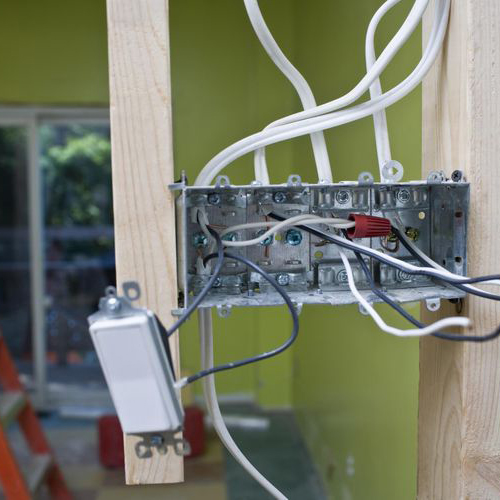
A rewire replaces the branch circuits that feed the house, and usually the panel that feeds them. It is not a cosmetic job and it is not a patch.
| Part of the job | What happens |
|---|---|
| New branch circuits | Modern grounded cable run to outlets, switches and fixtures, replacing knob and tube, cloth-covered or aluminum branch wiring |
| Panel and service | Most rewires include a panel change, and many include a service upgrade to 100 or 200 amps because the old service cannot carry the new load |
| Grounding | Proper grounding and bonding throughout, which is what turns two-prong outlets into safe three-prong ones |
| Protection | GFCI protection where the code requires it, kitchens, bathrooms, outdoors and garages, and arc fault protection on the circuits that call for it |
| Smoke and CO detection | Hard-wired, interconnected detectors, which is standard on a rewire and often the cheapest life safety improvement in the whole job |
| Notification and inspection | Filed with the Electrical Safety Authority by the contractor, inspected, and closed with a certificate |
What a rewire does not do is repair drywall and plaster to a finished state. Access holes are cut where wire has to be fished, and patching is either included in the scope or handled by your own trades. Get that written down before the work starts, because it is the single most common source of surprise at the end of a home rewiring project.

Does Your Ancaster House Need Home Rewiring?
Six signs, in the order they usually show up. Any two together make the conversation worth having.
- Knob and tube. Ceramic knobs on joists, tubes through studs, and cloth-covered wire in the basement. Most Ontario insurers will not renew a policy on active knob and tube.
- A fuse panel, or a 60 amp service. Both are signs the electrical system is original and the house has outgrown it.
- Two-prong outlets through the house. No ground means no protection for anything with a metal case, and no safe home for modern electronics.
- Breakers that trip as the house is used normally. Not once in a heatwave, but every week, on ordinary loads.
- Warm faceplates, scorch marks, or a faint burning smell. Stop reading and call. That is an emergency, and our emergency electrician line is answered 24 hours a day.
- An insurer or a buyer asking for an ESA certificate. When the paperwork is being demanded, the decision has effectively been made for you.
If lights flicker or part of the house goes dark instead, that may be a single fault rather than a whole-house problem. Our page on a partial power outage walks through what to check first.
Ancaster Housing, Era by Era
Ancaster spans about two centuries of building, and the era decides the job more than the postal code does.
| Era and area | What we typically find | Usual scope |
|---|---|---|
| Ancaster village, pre-1930 | Knob and tube, cloth-covered wire, 60 amp services, plaster and lath everywhere | Full home rewiring with a service upgrade |
| Post-war to 1960s | Early grounded circuits, undersized panels, additions wired by different hands over decades | Partial rewire plus a panel change |
| 1960s to late 1970s | Aluminum branch wiring at devices, 100 amp services | Copper tailing at every device, or a rewire where the house is being renovated anyway |
| 1980s to 2000s subdivisions | Sound copper wiring, panels that are simply full | Circuit additions and a panel or service upgrade, not a rewire |
| Newer estates | Modern wiring, spare capacity | New circuits for chargers, hot tubs, pot lights and finished basements |
The practical point is that a good quote starts with a look at what is actually behind the walls. Anyone quoting a home rewiring price for an Ancaster century home over the phone is guessing, and the guess will move once the first ceiling is opened.
Full Rewire or Partial
Not every old house needs everything replaced, and an honest contractor will tell you when a partial job does the work.
| Full home rewiring | Partial rewiring |
|---|---|
| Active knob and tube across most of the house | Knob and tube confined to one floor or a few circuits |
| Original service and panel, at or past capacity | Panel is sound and has spare positions |
| Walls already open for a renovation | Finished house where access is limited and disruption matters |
| Insurance demanding removal, not just isolation | Insurer satisfied with the original circuits gone |
| Three to five days on a typical house, sometimes longer | Often one to two days |
Where a house sits between the two, the sequence that usually saves money is to rewire the circuits that carry the load and are hardest to reach later, then handle the rest as rooms are renovated. That path only works if it is planned as one project rather than three unrelated visits.
How the Job Is Staged
Nearly every Ancaster home rewiring we do happens with the family still living in the house. The sequence exists to keep it that way.
- Survey and written scope. Panel, service, attic, basement and a sample of devices, then a scope that names circuits, devices, fixtures and who patches the walls.
- Notification filed. The contractor files with the ESA before work begins, never the homeowner.
- New circuits first. Power stays on the old wiring while the new runs go in, floor by floor.
- Cut-over. Circuits are moved to the new panel in groups, so the house is never fully dark for long.
- Service upgrade where required. This is the one day the power goes out properly, because the utility has to disconnect and reconnect. It is booked in advance.
- Old wiring disconnected. Removed where accessible, safely de-energised and abandoned where removal would mean tearing out finished plaster for no safety gain.
- Inspection and certificate. The ESA inspector attends, anything flagged is corrected and re-checked, and the certificate is issued.

What customers say
We bought old house knob and tube wiring huge project. Did a fantastic job.
Tom Hiller, homeowner
They also fixed a few things upstairs that were just wrong, and discovered a serious fire hazard a previous owner had hidden inside the walls.
Jason Rondeau, Hamilton
They were friendly, they did a fabulous job, they finished on time and they cleaned up everything when they were done.
Phil Buttersworth, Dundas
More of these are on our reviews page, and the full residential scope is listed under residential services.
What Moves the Price of a Rewire
Home rewiring is priced per house, not per square foot. Two houses of the same size on the same Ancaster street can differ by thousands of dollars CAD. These are the reasons, and any quote you receive should let you see them.
| Driver | Effect |
|---|---|
| Access | Plaster and lath with no basement below and no attic above is the expensive case. Open joists and a walkable attic is the cheap one |
| Size and circuit count | Priced by circuits and devices, not by square footage alone |
| Service upgrade | Whether the service, meter base and mast also have to be replaced, which brings the utility into the schedule |
| Removal versus abandonment | Physically pulling out old knob and tube costs more than de-energising and abandoning it, and insurers differ on what they will accept |
| Patching | Whether drywall and plaster repair is inside the scope or handled by your own trades |
| Extras taken at the same time | Pot lights, a charger circuit, hot tub wiring or a finished basement are far cheaper while the walls are open |
Apollo Electric quotes home rewiring from a site visit, in writing, with the scope broken down line by line. Call 905-921-5487 or request an estimate and you will have something you can hold against any other quote.
Five Questions to Ask Before You Sign
Rewiring quotes are hard to compare because contractors scope them differently. These five questions make two quotes comparable in about five minutes on the phone.
- What is your ECRA/ESA licence number, and who files the notification? The answer should be immediate, and the contractor should file it, not you.
- Is this a full or partial home rewiring, and which circuits are included? A quote that says "rewire house" without a circuit count is not a scope, it is a number.
- Is the panel or service upgrade in the price? Many quotes leave it out, then add it once the load calculation is done, which is where a cheap quote stops being cheap.
- Who patches the walls and ceilings? Get it in writing either way. This is the most common dispute at the end of a rewire.
- Is the old wiring removed or safely abandoned, and will my insurer accept that? Ask your insurer the same question before you choose, because the two answers have to match.
A contractor who answers all five plainly, in writing, is telling you how the job will actually run. One who avoids them is telling you something too.
Permits, Inspection and Insurance
Three pieces of paper matter on a home rewiring job, and only a licensed contractor can produce the first two.
- The ESA notification. Filed before or within 48 hours of starting notifiable work. The homeowner never files it.
- The certificate of inspection. Issued once the work passes. Keep it. Insurers, lenders and buyers all ask for it eventually.
- Your insurer's confirmation. Ask before the job what they need to see, because removal and abandonment are treated differently by different insurers, and that single answer can change the scope and the price.
Building permits are a separate matter handled by the City of Hamilton, and they are usually triggered by the structural or renovation work around a rewire rather than the wiring itself. More on how licensing and inspection work in Ontario is on our electrical safety page.
Frequently Asked Questions
Who is the best electrician in Ancaster for home rewiring projects?
The right contractor for a rewire is a licensed electrical contractor with an ECRA/ESA number, WSIB coverage, and real experience in your era of house. Apollo Electric holds licence 7009372, has rewired Ancaster homes for over 30 years, and quotes in writing from a site visit. Call 905-921-5487.
How long does home rewiring take?
A full rewire on a typical older Ancaster house runs three to five days, longer for large or difficult houses. Partial rewiring is often one to two days. A service upgrade adds a day and needs the utility booked in advance.
Can I stay in the house during a rewire?
Almost always. The work is staged so power stays on where you sleep and cook, and circuits are moved over in groups. The exception is the service change, which means a planned outage for part of one day.
Does home rewiring mean tearing the house apart?
No, but it does mean access holes where cable has to be fished, especially in plaster and lath. Wire is routed through basements, attics and closets wherever possible. Ask at quote stage who repairs the openings.
Will my insurance company require a certificate?
Usually, where knob and tube or aluminum wiring is involved. Ask your insurer what they need before the work starts, since some accept safe abandonment of old circuits and others require physical removal.
Do you rewire homes outside Ancaster?
Yes. Apollo Electric works across Hamilton, Dundas, Ancaster, Waterdown, Stoney Creek, Grimsby, Burlington, Oakville, Milton, Cambridge and Kitchener-Waterloo.
References
- Electrical Safety Authority, Ontario's electrical safety regulator.
- ESA, finding the right contractor, on licensing and the Authorized Contractor Program.
- Skilled Trades Ontario, on the Certificate of Qualification held by individual electricians.
- ThreeBestRated, electricians in Hamilton.
Apollo Electric Inc.
Planning a rewire in Ancaster? Start with a site visit.
Apollo Electric Inc., 83 Ferndale Ave, Hamilton, ON L8K 4L7
905-921-5487 · ECRA/ESA 7009372 · WSIB compliant · Serving Ancaster and the surrounding area