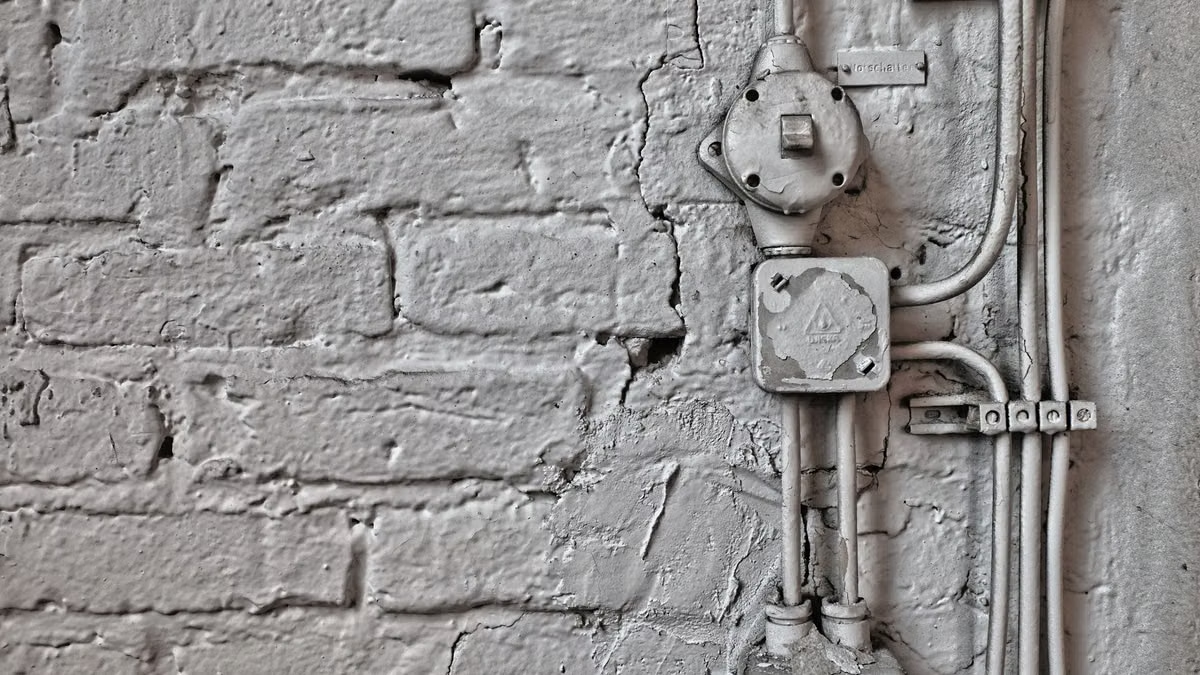
Old Wiring & Rewiring · Cambridge, ON
Knob and Tube Wiring in Cambridge
The law does not require you to remove it. Your insurance company is a different conversation, and that is the one that usually decides.

 WSIB compliant · 30+ years · Top 3 in Hamilton
Quick answer
Knob and tube wiring is not illegal in Ontario. The Electrical Safety Authority states it is safe provided it is properly maintained by a Licensed Electrical Contractor, and the Ontario Electrical Safety Code is not retroactive. What forces most Cambridge removals is insurance, because many insurers will not write or renew a policy on a house that still has it.
Knob and tube wiring gets talked about as though it were asbestos, and that is not what the regulator says. It is also not something to leave alone and forget. The accurate position sits between those two, and if you are buying, selling or insuring a house in Cambridge, the difference is worth real money to you.
Apollo Electric Inc. has rewired houses across Cambridge, Hamilton and the surrounding area for over 30 years under ECRA/ESA licence 7009372. This page covers what the Electrical Safety Authority actually says, why your insurer takes a harder line than the Code does, how to identify the wiring yourself, and what a removal involves once you decide to do it.
What It Is and Where It Hides
Knob and tube wiring is named after its two visible parts. Ceramic knobs hold the conductors away from the framing, and ceramic tubes line the holes where a conductor passes through a joist. The two conductors run separately, several inches apart, rather than bundled in one cable.
The Electrical Safety Authority dates knob and tube wiring to the early 1900s through to the 1940s, and it is no longer used. Almost any Cambridge house built before the Second World War started life with it, and a good number still have some.
That last point is the one people miss. Previous owners rarely removed knob and tube wiring completely. They added a panel, ran new circuits to the kitchen and bathroom, and left the original runs feeding the bedrooms and the hall light. The question is almost never whether the house has it, but how much is left, where, and in what condition.
The Law Does Not Require Removal. Your Insurer Might.
The Ontario Electrical Safety Code, 28th Edition 2021, deleted the installation rules for knob and tube wiring, so no one may install it today. But the Code is not retroactive. Existing installations are not made illegal by a later edition, and the Electrical Safety Authority states plainly that it is safe provided it is properly maintained by a Licensed Electrical Contractor.
Insurance is where the pressure comes from. The regulator's own guidance notes that many insurers will not provide or renew coverage on homes with knob and tube wiring, and some require replacement before they will write a policy at all.
So the honest framing is this. Nobody can order you to remove it on legal grounds alone. If your insurer declines the risk, you are choosing between a rewire and a house you cannot insure, and with a mortgage that is not really a choice. Decide on the insurance and the condition, not on a myth about legality.

Five Ways to Spot It Without Opening a Wall
You can get a strong indication yourself, from places you can already reach. Look, do not touch, and assume every conductor is live.
- Look in the attic and the basement. White or brown ceramic knobs on the joists, a single conductor over each, is knob and tube wiring itself. This is the clearest evidence there is.
- Count the holes at your outlets. Two slot receptacles with no round ground pin throughout a floor usually mean the original circuits still feed them.
- Check the sheathing on exposed runs. The original insulation was rubber and cloth, not plastic. Cloth that is cracked or flaking is a condition problem, not a method problem.
- Look at the age of the house. Pre-1945 construction in Galt, Preston or Hespeler is the profile, especially where the kitchen has been modernised and the bedrooms have not.
- Read the insurance paperwork. If a past policy asked about wiring type, somebody has already looked, and the answer is on file.
None of that replaces an assessment. The regulator's advice is to hire a Licensed Electrical Contractor to assess the system for signs of deterioration or damage, and that is what turns a guess into a decision. The checks for choosing one are under how to hire a licensed electrician.
Should Knob and Tube Wiring Be Removed?
Our answer, after three decades of opening these walls: usually yes, but for reasons about condition and modern load, not because knob and tube wiring is inherently defective.
Remove it when any of these are true, and most houses hit at least one:
- Your insurer requires it. This decides more rewires than every other reason combined.
- The conductors are deteriorated. Brittle, cracked or missing insulation is not a maintenance item, it is a replacement.
- It has been modified by an amateur. Splices in junction boxes that were never meant to take them, extensions in plastic cable taped to the originals, and circuits extended to a basement apartment. This is the most common thing we actually find.
- It is buried in insulation. Knob and tube wiring relies on air around each conductor to carry heat away, so blown-in or batt insulation packed over it defeats the design.
- You are renovating anyway. Opening walls for any other reason is the cheapest removal you will ever get.
- You need grounded circuits. There is no equipment ground, so kitchens, bathrooms, laundry and outdoor receptacles cannot be brought to current protection standards on it.
Leave it, maintained and monitored, only where the runs are intact, uncovered, lightly loaded, unmodified, and your insurer is content. That combination exists, but it is rarer than homeowners hope.

Where It Actually Becomes Dangerous
Knob and tube wiring did its job for decades in houses drawing a fraction of what yours draws. Four things turn it from safe-when-maintained into a problem.
| What changed | Why it matters |
|---|---|
| Insulation added over the runs | The design depends on open air around each conductor. Bury it and the heat has nowhere to go |
| Modern load on original circuits | A bedroom wired for a lamp now runs a space heater, a desktop and a window air conditioner |
| No equipment ground | No ground path means no proper protection for anything with a metal case, and no basis for a grounded receptacle |
| Decades of amateur modification | This is the one we find most. The original work is often sound. What was added to it is not |
Deterioration sits underneath all four. Rubber and cloth does not stay flexible for eighty years, and insulation that cracks when disturbed is why an attic holding knob and tube wiring is worth inspecting before anyone moves things around up there. If you are already seeing circuits dropping out or protection that keeps operating, treat that as the assessment calling itself.
What a Removal Involves, Step by Step
Removing knob and tube wiring is a trade job and a renovation job at once, and knowing the sequence makes competing quotes comparable.
- Assessment. A licensed contractor maps what is left, what condition it is in, and how much can be reached without opening finished walls.
- Notification of work filed with the Electrical Safety Authority. The contractor files it, before the work starts, never you. We explain why that matters under electrical safety and compliance.
- Panel and service assessed. A rewire usually arrives with a panel or service upgrade, because the old board rarely has the capacity or the spaces.
- New circuits run. Attic down and basement up first, since those runs are accessible. Finished walls are fished where possible, opened where not.
- Devices replaced. Grounded receptacles throughout, with protection added where the Code now requires it in kitchens, bathrooms, laundry and outdoors.
- Old conductors removed. Knob and tube wiring abandoned in place is a problem for the next owner and the next inspection, so it comes out rather than staying behind the plaster.
- Inspection and documentation. Then paperwork to you, which is what your insurer and your eventual buyer want to see.
What moves the price
We quote after the assessment rather than over the phone, because the spread is genuinely wide and a phone number would be a guess. These factors move it, in order of impact:
- How much is accessible. An unfinished basement and a walk-up attic can halve the labour against finished ceilings on every floor.
- Number of circuits and devices, not square footage. A compact house with many rooms costs more than an open one of the same size.
- Plaster and lath versus drywall. Lath does not patch or fish like drywall.
- Whether the panel and service also need upgrading, which on a pre-war house they usually do.
- Making good. Decide early whether patching and painting sits in your quote or with you, because it is a real line item either way.
Cambridge Homes: Galt, Preston and Hespeler
Cambridge is three historic communities that amalgamated, each with housing old enough for this to be a live question. Galt's core, Preston's older streets and Hespeler's mill-era houses all contain pre-war homes wired with knob and tube wiring and added to ever since.
One local detail worth getting right, because most pages about Cambridge still have it wrong. Cambridge electricity is distributed by GrandBridge Energy, not Energy+. Energy+ Inc. and Brantford Power merged on 2 May 2022 to form GrandBridge Energy, which now serves Brantford, Cambridge and the Township of North Dumfries. The 24 hour outage and emergency line is 1-833-769-3701, also written as 1-833-POWER-01.
That number matters on this job. Removing knob and tube wiring alongside a service upgrade means the utility disconnects and reconnects at the meter, and if something goes wrong at the service during the work, the utility is the call, not the electrician. For a downed line or a fire, call 911 first, every time.
Apollo Electric works across Cambridge, Hamilton, Ancaster, Dundas, Burlington and the surrounding area. To have your wiring assessed before you talk to an insurer, get in touch or call 905-921-5487. We will tell you what is there and what it needs, including when the answer is that it needs nothing yet.
Frequently Asked Questions
Is knob and tube wiring illegal in Ontario?
No. The Ontario Electrical Safety Code, 28th Edition 2021, deleted the installation rules so it cannot be installed today, but the Code is not retroactive and existing installations are not illegal. The Electrical Safety Authority states the wiring is safe provided it is properly maintained by a Licensed Electrical Contractor.
Will insurance cover a house with knob and tube wiring?
Often not. The Electrical Safety Authority notes that many insurers will not provide or renew coverage on homes with this type of wiring, and some require replacement before issuing a policy. Policies differ, so ask your insurer directly and in writing before you buy a pre-war house in Cambridge.
How can I tell if my house has knob and tube wiring?
Look in the attic and the basement for white or brown ceramic knobs on the joists with a single conductor over each. Two slot receptacles with no ground pin throughout a floor are a second sign, and cloth covered conductors are a third. A licensed electrical contractor's assessment confirms how much is left and its condition.
Does knob and tube wiring have to be removed before selling a house?
There is no legal requirement to remove it before a sale. In practice it affects the transaction anyway, because a buyer's insurer may refuse coverage, which can delay closing or move the price. Getting an assessment and documentation before listing puts you ahead of that conversation rather than behind it.
Is it safe to put insulation over knob and tube wiring?
No. The method relies on open air around each conductor to carry heat away, so covering the runs with blown-in or batt insulation defeats how it was designed to work. If insulation has already been added over active original circuits, have a licensed electrical contractor assess the situation before adding any more.
Does Apollo Electric remove knob and tube wiring in Cambridge?
Yes. Apollo Electric Inc. is a Licensed Electrical Contractor under ECRA/ESA licence 7009372, serving Cambridge, Hamilton, Ancaster, Dundas, Burlington and the surrounding area. We assess what is present, file the notification of work with the Electrical Safety Authority, rewire, and hand you the documentation your insurer will ask for.
References
- Electrical Safety Authority, knob and tube, on the era it was installed, the Code not being retroactive, and insurance coverage.
- Electrical Safety Authority, hiring an electrician or contractor, on why only a Licensed Electrical Contractor may be hired for this work.
- Electrical Safety Authority contractor locator tool, for verifying an ECRA/ESA licence before you hire.
- GrandBridge Energy outage centre, Cambridge's electricity distributor and its 24 hour line.
- Insurance Bureau of Canada, on home insurance and property risk in Canada.
Apollo Electric Inc.
Find out what is actually in your walls before your insurer does.
Apollo Electric Inc., 83 Ferndale Ave, Hamilton, ON L8K 4L7
905-921-5487 · ECRA/ESA 7009372 · WSIB compliant · Answered 24 hours a day